The post The Private Sector Construction Playbook : Trust and Productivity appeared first on Zaun Limited.
]]>With the launch of Trust and Productivity: The private sector construction playbook we wanted to look at some of the key areas raised in the new playbook and how they relate to physical perimeter security and external works.
Historically, the UK construction industry has been characterized by a lack of openness, poor productivity, and a failure to invest in innovation. Whilst much progress has been made in addressing the problems, efforts have been focused solely on the public sector. Lessons learned through the supply chain in dealing with these issues help to form part of a new look for the private sector.
One of the biggest lessons learned in terms of physical perimeter security and external works has been the early engagement with the supply chain and the drive to standardisation. Lets us break down why these two areas are so important not just in delivering productivity within the construction process but also in additional value opportunities.
The following example demonstrates the difference between early engagement and without it.
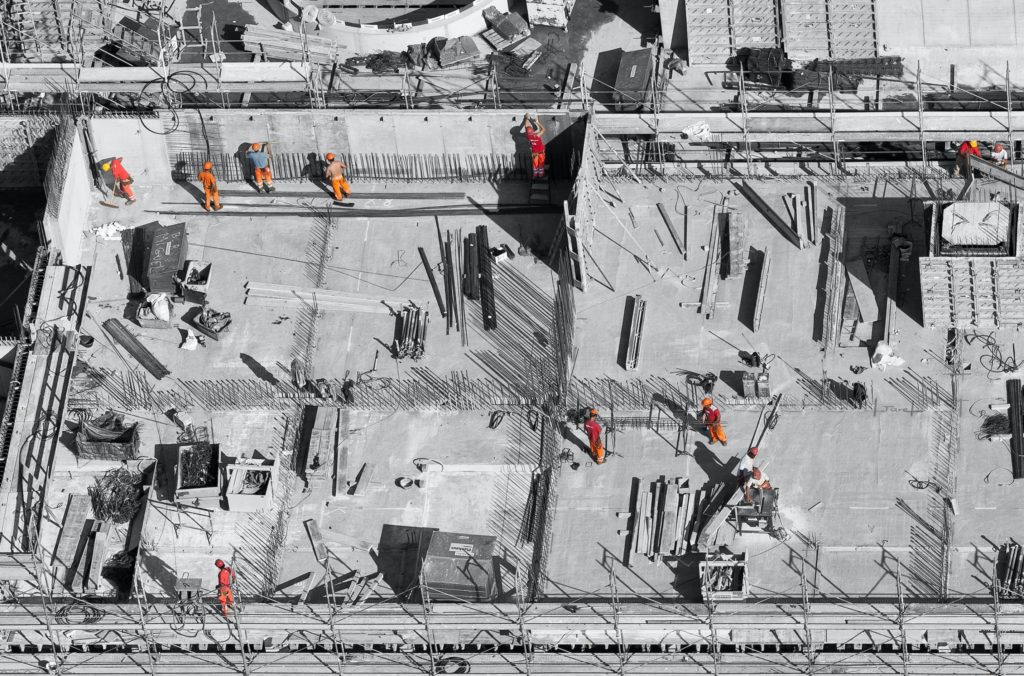
Early Engagement
Project A has a need for a security-rated fencing system that offers a 3 min minimum delay against attack. They want the system to be cost-effective through savings on materials and installation. They expect the fencing system to be designed, manufactured, and supplied within a set time frame due to site security requirements.
Project A team puts out an open call to all fencing manufacturing companies to present their solutions with added additional value. They conduct an open day where they learn the following:
- There are multiple solutions in the marketplace.
- Some solutions are double skins and some solutions are single skin, they can demonstrate quicker installation from a single skin system which reduces overall project costs. They discover that the fencing system needs to be LPS 1175 B3 (SR2) to deliver the required security rating.
- By using a standard industry height they can remove excessive design work and material waste in the manufacturing process so reducing the embodied carbon on the system as well as reducing the lead time for manufacturing.
- They discover that as there are multiple systems they can maintain competitiveness which can drive cost efficiencies in the project.
- Through early engagement they are able to prime the manufacturers for the scale, scope, and time frames required for the project. With the early selection of the system, they are also able to vest the manufacturing materials to hold the price of the raw materials and manufacturing costs.
- They are able to discuss standard widths for their ingress and egress solutions so that they can use ‘stock’ widths that require less design time and speed up the manufacturing process.
- Project A team feels that they have a solution that matches their needs, wants, and expectations as well as delivering added additional value to the project.

Without Early Engagement
Project B has a need for a security-rated fencing system that offers a 3 min minimum delay against attack. They want the system to be cost-effective through savings on materials and installation. They expect the fencing system to be designed, manufactured, and supplied within a set time frame due to site security requirements.
Project B team decides against any early engagement and decides to work on the project alone, leaving it to the subcontractor when appointed to deliver the required security-rated fencing system on a supply and install price. Project B sets a price per linear metre (PLM) as a budget cost based on current prices in the marketplace and selects fencing heights and gate widths based on what they think they need.
Project B team discovers the following when it comes time for the fencing system to be installed.
- They have one solution that is offered to them by the subcontractor
- The price they budgeted for the project no longer covers the rising costs in material prices and the fencing and gates are now over budget.
- The height of the fencing system was nonstandard and resulted in more manufacturing waste in its production which has increased the embodied carbon as fencing panels needed to be cut down to size for the project.
- Due to nonstandard heights and widths, excess design time was required across the fencing and gate systems which resulted in a longer lead time for design and manufacturing. This has had an impact on the timeline for the project.
- Project B has delivered the needs for the project but has not delivered added additional value and is unsure if the ‘best’ solution has been used. They have paid more for the solution than Project A team
Both of these are actually real-world examples of projects that Zaun has seen over the last 26 years as the last British in-house manufacturer of woven and welded mesh fencing systems. However, Project A has tended to be Public Sector Projects, Utilities, and Frameworks whereas Project B has always centered on Private Sector projects.
The private sector construction playbook outlines the following for market engagement:
Engaging with the construction supply chain ahead of a formal procurement process enables clients and contractors to plan and allocate resources, and lets suppliers become familiar with the project.
Ask the supply chain as soon as possible about the mechanics of the procurement process, how the works should be taken to market, and buildability, logistics, material availability, and programming. Involvement of the supply chain in this way will provide technical and specialist design input at the earliest stage of the project and encourage innovation.
Likewise, it allows the project team to ask key questions to assess the capability of the supply chain, such as:
- Does the supplier/manufacturer have a proven track record and ability to manage the nature and risk profile of the project?
- Does the supplier/manufacturer have the capacity as a business to take on a specific project?
You can read the full document here – https://media.bethebusiness.com/documents/5195_Construction_Brochure_SinglePgs.pdf
So how will you work with the supply chain moving forwards? With you be Project A or Project B?

The post The Private Sector Construction Playbook : Trust and Productivity appeared first on Zaun Limited.
]]>The post What are the advantages of using RDS fencing? appeared first on Zaun Limited.
]]>In the next sections, we’ll look at some of the real-world benefits businesses can gain when they opt to fit this simple but secure fencing on their premises.
A single solution to many problems
RDS fencing provides the perfect temporary security option for a wide range of situations. If your firm wants to keep particular areas protected from unauthorised access or is looking to make potentially dangerous places off-limits while work is conducted, RDS is ideal. It is also exceptional for controlling crowds and can function as a robust and dependable barrier at public events.
Economic issues
Enterprises operating within a strict security budget will find that PAS 68-rated RDS fencing can be advantageous. Due to its outstanding levels of protection, RDS can cut down the costs incurred from additional security personnel and patrols that are commonly associated with temporary fencing.
Deploy and redeploy as necessary
Firms will find that RDS solutions offer excellent flexibility. They have been designed to allow security teams to react swiftly and move their defences to key areas where stronger measures are urgently required with little effort and disruption.
Customisable and dependable
High-quality RDS fencing can be counted on in extreme circumstances. Independently tested to rigid standards, they are capable of holding their own against crowd swarming. They can also be installed with access portals designed for both people and cars when necessary.
RDS is also easy to integrate with additional security measures such as CCTV, perimeter intrusion detection systems and an extensive range of fence toppings. Although HisSec 358 mesh features in the standard-issue product, those buying RDS can approve the appropriate type of mesh that best fits their requirements.
Innovative fencing solutions you can trust
At Zaun, we develop, make, and fit government-approved fences that enable us to offer our clients full service and expert advice. So get in touch with us today to put a stronger security solution in place swiftly.
The post What are the advantages of using RDS fencing? appeared first on Zaun Limited.
]]>The post 4 of the best uses for mesh fencing appeared first on Zaun Limited.
]]>1. Security
Mesh fencing is commonly used as a perimeter wall or security fence. It can offer security purposes to residential, industrial or commercial properties. Mesh is also a popular choice for securing homes, however, this is often combined with a form of fencing that is generally considered more aesthetic. For increased security, some people choose a type of mesh fencing that prevents finger holds or tools being able to cut through, due to the extremely small openings.
2. Public Parks
As mesh fences can be installed in various different colours, some people enjoy the look of it in their local parks. For those who are passionate about plants, a mesh fence is a good alternative to wires for plants that climb, as they can easily take the weight without having to be regularly repaired, unlike the alternative.
3. Animals
Mesh fencing is a popular choice for fencing in animals, no matter what they are. As it’s possible to purchase the fence with different sizes of holes, it can accommodate any form or size of the animal. Some of the most common options are horse fencing, rabbit fencing and chicken coops. It is also an extremely safe option for animals, due to the lack of sharp edges.
4. Highways and railways
One of the main industrial uses of mesh fencing is on highways and railways for security purposes. They are extremely beneficial for preventing damage of the tracks, and also to prohibit animals from crossing over dangerous areas.
To shop our range of premium mesh fencing, don’t hesitate to visit our website, or contact us at Zaun for information and guidance.
The post 4 of the best uses for mesh fencing appeared first on Zaun Limited.
]]>The post The business benefits of an RDS fencing systems appeared first on Zaun Limited.
]]>What are the numerous advantages organisations can enjoy when they choose this innovative solution?
A multi-purpose system
RDS fencing is an ideal temporary security measure suited to a diverse range of applications. Whether you need to erect a barrier to keep back crowds at a sporting event or rally or shield areas from unwanted visitors or trespassers to a construction site, RDS offers strong support.
Enhanced agility
RDS fences offer organisations flexibility. We have designed these fences for straightforward, rapid deployment when necessary allowing onsite security to react fast and establish new defences swiftly and smoothly while causing minimal disruption.
Comprehensive onsite security
The RDS range has been independently tested against mob attacks and repels crowd strikes. An optional PAS 68 enhancement is also available to provide hostile vehicle mitigation to the fencing, gates and access portals.
Cost-effective
This PAS 68 rated fencing’s impressive protection levels can allow business users to cut costs. In addition, it dramatically reduces the need for additional security teams and policing, often required by conventional temporary barriers.
Convenient to customise
Fully customisable, RDS works well with a wide range of security enhancements like fence toppings, perimeter intrusion detection systems (PIDs) and Closed-circuit Television (CCTV) cameras. Matching security gates can also be added in the same style as the RDS, offering the same formidable protection levels. While HisSec 358 is used as standard, purchasers can select the mesh used in RDS fencing to suit their needs.
Specialists in high-security fencing
Developing and manufacturing government-approved security solutions at Zaun, we can advise on all your onsite needs. Contact our specialist team to discuss the fastest way to establish robust measures at your event or enterprise premises now.
The post The business benefits of an RDS fencing systems appeared first on Zaun Limited.
]]>The post Common construction site security errors to avoid appeared first on Zaun Limited.
]]>But which are the most common to avoid?
Not having adequate perimeter fencing.
All site operators will be aware of how essential it is to have robust boundaries such as perimeter fencing installed at the site for safety and security. This helps to stop unauthorised people from getting onto the site and potentially injuring themselves. It also stops people passing by the site from being injured by machinery or debris. In addition, fencing is key for construction site security as it stops intruders from stealing materials or equipment. However, one error on many sites does not have adequate fencing.
Heras type fencing is commonly used to protect a construction site; however, this type of fencing may not provide your site with an adequate level of security and protection to protect the site from potential thieves or trespassers. If your fencing does not cover the whole perimeter fully or is not strong or tall enough, it will not keep the site secure.
Not controlling access
While construction site security can focus mainly on what happens when workers are not around, this is not the only thing to consider. For example, a big mistake many sites make is not properly controlling access during the day. This can see people simply wandering onto a site and helping themselves with tools or materials but putting themselves at risk, and you at threat of a lawsuit. But, of course, it could also threaten workers’ physical safety if the intruder attacked them. Therefore, ensuring you control access to any site via monitored access points is a must.
Not using cost-effective construction site security products.
Whilst hoarding is a common and most popular method of protecting a construction site, it is not necessarily the most cost-effective method to protect the site. Zaun’s latest addition to our temporary fencing range RDS StrongHold is not only a rapid deploy fencing system, but the fencing panels used to secure the construction site temporarily may also be used as part of the construction of the permanent perimeter, providing a carbon-efficient way to create a perimeter. Available with a wide variety of fencing panels, from Profile mesh to 358 mesh, this system enables you to select the fencing to the level of security required to secure the site.
Call Zaun for construction site security products
If you need top-class woven or welded mesh temporary fencing for your site, call Zaun today on 01902 796699. Get in touch for more information.
The post Common construction site security errors to avoid appeared first on Zaun Limited.
]]>The post Zaun Rapid Deploy System (RDS) family extended appeared first on Zaun Limited.
]]>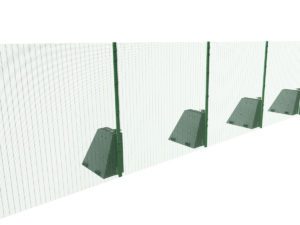 “Zaun RDS Original” was introduced in 2012 and has since been widely used at major events throughout the UK. It was a pioneering product providing a surface mounted, rapid deploy fence that was properly resistant to the natural elements and a malicious attack. Now, in 2021, Zaun is expanding the family with the RDS StrongHold range.
The RDS StrongHold system incorporates a patent-pending adjustable system to plumb the posts; this means that not only will the perfectly vertical posts be more pleasing to the eye, but a wider range of panel types can be mounted, including panels that must have accurately plumbed and positioned posts. The StrongHold range will work with all Zaun mesh systems: Axiom 3D mesh, Optima, Duo, 358 and ArmaWeave.
The bases for RDS StrongHold utilise legacy material from the Glasgow 2014 Commonwealth Games. Originally designed to support temporary CCTV columns, these bases were conceived to split into two smaller fencing bases. Still, it is only now, with the launch of our patent-pending adjustment system, that they are available for sale. Utilising these bases is great up-cycling and provides a significant reduction in the carbon footprint of this product compared with virgin materials.
Housed on the inside of the perimeter to remove any form of climbing aid or tripping hazard to the attack site for the fence, these 455kg steel-clad concrete bases provide excellent overturning resistance to provide a strong and secure fence.
Each 450mm x 900mm x 800mm concrete base is fixed to the post using the unique adjustable fixing system. This allows the fence to be installed on uneven ground, keeping the posts plumb without the necessity to chock the blocks. 358 mesh can be stepped or can be angled to follow the contour on the ground, in the latter case by overlapping the mesh to suit. Other panels, such as Axiom, cannot overlap as the V beams would interfere, so these types of panels must be stepped on the plumb post.
Available with a variety of mesh types, including 358 mesh, profile mesh and twin wire mesh. Any chosen mesh can also be used subsequently as part of a permanent installation, without the need for new panels or may be used again and again on multiple temporary sites.
RDS StrongHold was named after Zaun ran an internal competition amongst staff. After much deliberation, RDS StrongHold was chosen from hundreds of entries and won by Kevin Lloyd, one of our experienced fabricators.
The post Zaun Rapid Deploy System (RDS) family extended appeared first on Zaun Limited.
]]>The post How to choose the right wire mesh panels appeared first on Zaun Limited.
]]>What kinds of wire mesh panels are available?
The first thing to consider is what kind of wire mesh fencing is best for your purposes.
Profile mesh fencing, which consists of ‘V’ beams crimped into the panel, is commonly used in schools, parks and other sites which require low-level security.
358/prison mesh fencing, with close-knit apertures, is used in security settings, including prisons and ports etc., also commonly called anti-climb mesh.
Twin-wire mesh fencing, featuring double wire horizontals, makes the fencing strong, ideal for sports pitches, MUGAs and perimeters not likely to sustain forcible attacks.
Double-layer mesh fencing (double skin 358), which combines two layers of mesh for even more security, is usually used on high-security sites such as data centres or prisons.
Check the quality of the steel.
When you’re investing in wire mesh fencing for security, it’s important to make sure that the steel used in the production of your chosen fencing is good quality, strong, and durable. In addition, steel wire should be traceable back to an ISO 9001:2015-accredited source, which means it meets contemporary standards for this kind of product.
It’s also important to find out when your chosen steel was galvanised because it will determine some key facts. For example, steel should be galvanised after welding so that the mesh’s protective zinc coating isn’t removed by the welding process. On the other hand, zinc alloy coated or pre-galv fencing can be galvanised before welding because of its higher aluminium content.
Choosing the diameter of your steel wire
The diameter of the steel wire which your mesh fencing is made up of will also affect the strength of your fencing. The diameter of the wire and the amount of wires generally affects the security level of the fence. The thicker the wire used in your mesh fencing, the stronger the fence will be; the more wires the fence has increased the delay to any miscreants.
More from Zaun
At Zaun, we know our fences. So if you’re looking for fencing and security specialists to help you draw up a tailored security design for your premises, get in touch with us. We’re always happy to provide friendly advice and tips.
The post How to choose the right wire mesh panels appeared first on Zaun Limited.
]]>The post What potential security risks should construction sites focus on? appeared first on Zaun Limited.
]]>Supplies going missing
One of the most obvious security risks you could face on any site is the theft of supplies. This could be anything from bricks to cabling, copper wiring and beyond. Any building materials can go walkies if you do not have the site secured properly. While theft by construction site staff can sometimes be an issue, people coming onto the site pose the biggest threat.
Damage/theft of plant machinery
Next to building supplies being pinched, any plant machinery you have on-site is also a potential risk. This can be in the form of intruders breaking into the site to steal the machinery. It could also simply be damage to machinery or vehicles which are left on-site overnight. Both of these situations will cost you valuable time and money to fix.
Vandalism to buildings
The other major security issue can be intruders getting onto the site in the evenings to graffiti buildings. This can be especially true with half-finished buildings, which are easier to gain entry to. As with damage to vehicles or machinery, this will incur precious time and money to remedy.
How can you protect against these construction site security risks?
By far, the best idea is to ensure you have effective temporary security fencing around your site. Making sure you have tough and durable perimeter fencing is essential to keep intruders out. Not only does fencing provide a physical barrier, but it also deters people from even trying to gain access. Top-quality fencing will also make your site more professional and keep people passing by safe from dangerous construction work.
Call Zaun for the best perimeter fencing.
Construction site security risks are not a joke and something you must get right. So if you are looking for durable and tough fencing for your site, call Zaun today on 01902 796699 or email sales@zaun.co.uk.
The post What potential security risks should construction sites focus on? appeared first on Zaun Limited.
]]>The post Zaun uplifts SR range to latest BRE standard appeared first on Zaun Limited.
]]>BRE has revised its SRs to Loss Prevention Standard (LPS) 1175 as certified by the Loss Prevention Certification Board (LPCB) and listed in their Red Book.
The latest revision of LPS1175 to issue 8.0 sets out the requirements and testing procedures for the LPCB certification and listing intruder resistant building components, strongpoints, security enclosures and free-standing barriers following extensive consultation with stakeholders.
Zaun sales and marketing director Chris Plimley said: “It’s essential to keep up to date on any new standards as they reflect developments in the techniques being used by terrorists and other criminals. Plus, several major tenders emerging this year will insist upon issue 8 certifications.”
Zaun received its new certifications from BRE at the International Security Expo, where its products were submitted to live attack by testers in the LPCB Live Test Lab & Zone.
Issue 8.0 has adapted the previously single-digit performance classifications (i.e. SR 1 to SR8) to one formed of two elements that classify performance in terms of:
- Threat level (first element) – letter (A to H) corresponding with the tool kit used to evaluate the product’s intruder resistance and the number of attackers involved.
- Delay (second element) – numeric value (1, 3, 5, 10, 15 or 20) corresponding with the minimum delay in minutes provided by the product when placed in a locked condition.
The LPCB says that although the new two-part classifications cover 48 combinations of threat and delay, it is considered unlikely that most specifiers, end-users and regulators will require individual products to achieve security ratings contained within the black boxes (see table).
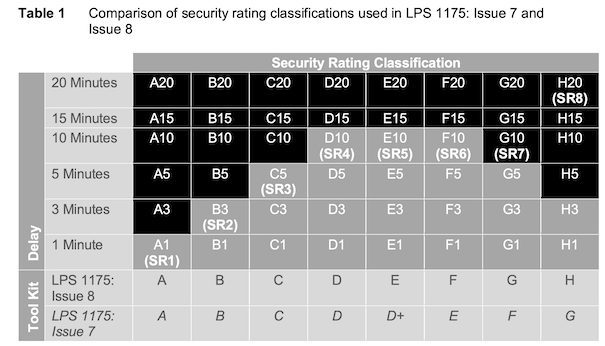
Instead, they are more likely to achieve an extended delay by deploying a series of products in a layered approach, a strategy that is supported by the classification system introduced within this standard.
For example, it is considered a 10-minute delay against a level ‘F’ threat is more likely to be achieved by deploying two layers formed of products that achieve an ‘F5’ security rating instead of a single layer formed of products that achieve an ‘F10’ security rating.
Plimley said: “I really like this layered approach to time delays as it better reflects realistic solutions to the real-life threats critical national infrastructure faces, and it is consistent with the ‘onion skin’ principle of successive rings of security the closer an intruder gets to the most sensitive assets.”
Issue 8.0 products approved by LPCB are rigorously tested for resistance to deliberate attack and play an important role in protecting people and property against physical attack, burglary, vandalism and terrorism.
To maintain accreditation, manufacturers must regularly demonstrate to independent auditors that they produce products consistent with those tested. This gives the customer the guarantee that they are getting a secure and quality product.
The post Zaun uplifts SR range to latest BRE standard appeared first on Zaun Limited.
]]>The post Welded vs woven mesh fencing appeared first on Zaun Limited.
]]>Structure
Welded mesh fencing has either rectangular or square spaces created by laying wires in a vertical and horizontal latticework. The wire intersections are then spot-welded, creating a sheet. Welded wire fencing is pretty simple to design compared to woven wire. Woven mesh fencing is made using a machine that loosely twists the wire into gentle spirals that overlap at the ends. Woven wire fencing has a distinct zigzag diamond shape.
Pros and cons
Due to the structure of welded mesh, thicker metal wires are used to make it. It is rigid, durable and has unmovable stability. Wires do not unravel from one another when a welded mesh wire is cut, making it easier to maintain. Other security measures such as CCTV cameras and security lighting are easily used alongside welded mesh fencing. The only disadvantage of this design is that when a lot of pressure is introduced, the permanent deformity will most likely occur, and the fence will need to be replaced.
Woven mesh fencing can bend, pull and twist without breaking because of its loose structure, and it is, therefore, able to perform incredibly well under pressure. In some cases, the vertical wires are made using one continuous strand for more support and strength. This design also allows you to be more creative with patterns for a more aesthetically pleasing finish.
Both of these designs perform exceptionally well, and you have to understand what will best work for your needs. For example, the welded mesh is suitable for construction projects and high-security fencing. Woven mesh, on the other hand, is great for fencing grazing fields.
Looking for welded mesh or woven mesh fencing? Contact Zaun today!
The post Welded vs woven mesh fencing appeared first on Zaun Limited.
]]>