The post Who’s Really Protecting Your Perimeter? appeared first on Zaun Limited.
]]>Why weld strength matters more than just wire gauge
In the world of 358 mesh fencing, not all panels are created equal. Many companies market panels by quoting wire thickness such as 3.9 mm, 4.0 mm, etc. But that metric alone doesn’t tell the full story.
We recently carried out a series of destruction tests on three 358 panels to compare real-world performance. The results show why relying on wire thickness alone can leave your perimeter exposed. We chose 358 as it is often seen as a High Security Fencing system and therefore a safe panel for many projects such as schools, transport and logistics, and commercial projects.
The Test Setup & Results

| Panel | Origin | Wire Diameter (mm) | Failure Load | % of Wire Tensile | Result |
|---|---|---|---|---|---|
| Panel 1 | UK | 3.96 – 3.99 | 4.9 kN | ~75% |  PASS PASS |
| Panel 2 | Turkey | 3.76 – 3.77 | 2.4 kN | 36.64% |  FAIL FAIL |
| Panel 3 | China | 3.86 – 3.90 | 0.8 kN | 12.21% | FAIL |
Panels 2 and 3 are currently being sold into the UK market, despite failing at less than half, and in one case less than one-sixth, of the strength of the UK-manufactured panel. How do we know? Because the manufacturers approached us directly and sent these very samples as their best examples. They even told us which UK fencing companies they already supply.
“These weren’t random imports. The manufacturers sent us these samples as their best panels to prove quality. They still failed.”

Why Weld Strength Is the Real Gatekeeper
“A mesh fence is only as strong as its weakest weld.”
1. The weakness is at the joints
In a mesh panel, the points where wires cross are welded. If those welds are poorly made, for example under-penetrated, porous, or inconsistent, they will fail well before the wire itself breaks. This is exactly what we saw in Panels 2 and 3.
2. Wire thickness ≠ panel strength
Thicker wire alone doesn’t always guarantee security. In our test, the Chinese panel used almost the same wire size as the UK panel, but it still failed at just 0.8 kN. The reason, its welds could not sustain the load.
3. Real-world loads demand reliable welds
From crowd loading to climbing attempts, fences experience repeated stresses and sudden impacts. If welds crack or shear under these loads, the perimeter is compromised. International standards specify testing because weld quality is mission-critical.
4. Quality control makes the difference
Strong panels require not just the right design, but also rigorous inspection and destructive sampling. That’s what ensures every batch performs consistently, not just on paper.
What to Ask Your Supplier
- Weld shear test data – not just wire diameter.
- Batch quality control – how often are destructive tests run?
- Standards compliance – do they meet BS 1722 requirements?
Watch the Test for Yourself
It is not the size of the wire that keeps a site secure, it is the strength of the weld. In our tests, the UK panel withstood more than double the destructive load of the Turkish panel, and over six times that of the Chinese panel.
The Turkish panel had the thinnest wire (average 3.765 mm), around 5.3% thinner than the UK panel (average 3.975 mm). It performed better than the Chinese panel (average 3.88 mm), but still failed at less than 40% of the overall tensile strength. The Chinese panel failed at less than 13% of the overall tensile strength. The UK panel passed at 4.9 kN, equal to 75% of the tensile strength.
You can see the results for yourself in the video below:
Final Word
Don’t be misled by numbers on a datasheet. A panel can look the same and feel the same but when tested, weak welds fail well before the wire does.
If you’re responsible for protecting a perimeter, insist on weld test data, not just wire thickness. It is the welds that stand between a secure site and a serious breach.
We invite you to visit our mesh manufacturing facility and see a destruction test in person. Contact us today to arrange your visit.
The post Who’s Really Protecting Your Perimeter? appeared first on Zaun Limited.
]]>The post Perforated Fencing and Gates: A Secure and Stylish Upgrade appeared first on Zaun Limited.
]]>Safety and Security with Perforated Fencing
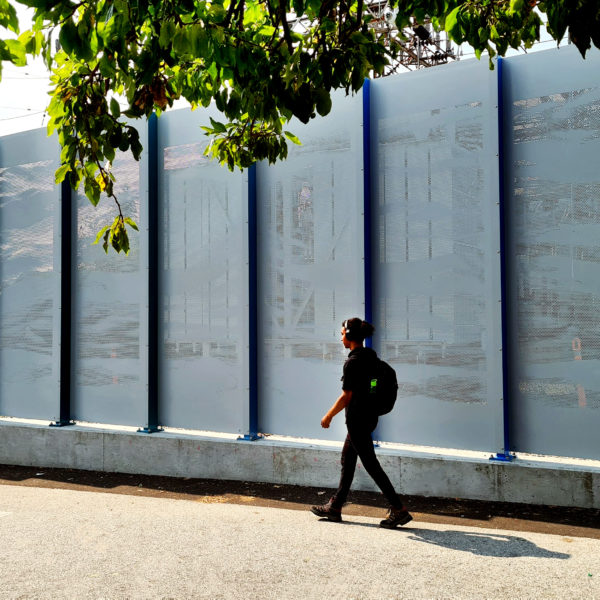
Safety is a top concern for specifiers and fencing contractors. Traditional laser-cut fencing poses a risk due to sharp edges. Picture-perf fencing eliminates this hazard with its perforation process. This method creates intricate designs without compromising the metal’s integrity, resulting in a smooth, safe surface for everyone around the fence or gate.
Unmatched Strength and Durability for Long-Term Protection
Specifiers require fencing solutions that can withstand the elements and resist physical challenges. Picture-perf fencing by Zaun delivers exceptional strength and durability. The perforation process removes minimal material, preserving the structural integrity of the fencing. This stands in stark contrast to laser-cut fencing, which weakens the metal by removing sections. Consequently, picture-perf fencing offers superior resistance to impact, vandalism, and harsh weather conditions, making it a reliable long-term security solution.
Beyond Security: Unleash Your Design Potential with Perforated Fencing and Gates
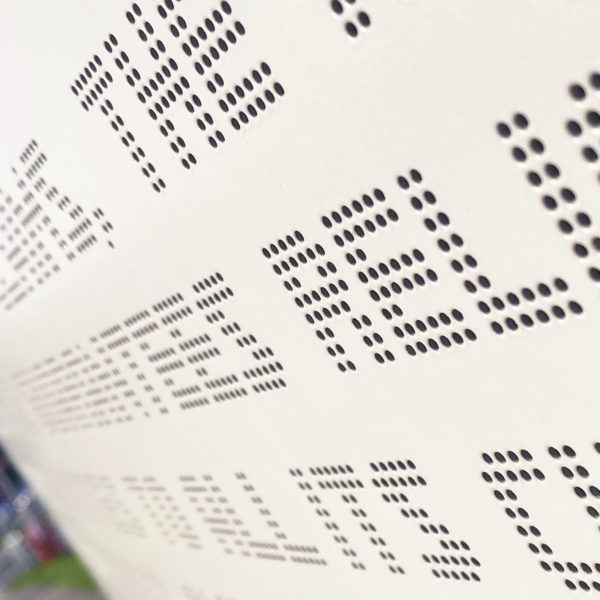
While safety and durability are crucial, specifiers often seek fencing solutions that complement a project’s aesthetics. Picture-perf fencing by Zaun surpasses expectations in this regard. The perforating technology facilitates the creation of a vast range of designs, from intricate geometric patterns to photorealistic images. This allows for seamless integration of the fencing or gate into the project’s design, transforming it from a functional necessity into a visually striking element.

Applications for Perforated Fencing and Gates
The versatility of picture-perf fencing makes it suitable for a wide range of applications, including:
- Schools and Playgrounds: The safety features and ability to incorporate colorful designs or mascots make picture-perf fencing ideal for securing schools and playgrounds.
- Public Buildings and Spaces: Perforated fencing with intricate patterns or building logos can elevate the visual appeal of public areas.
- Commercial Properties: Businesses can leverage picture-perf fencing to enhance their brand image by incorporating logos or other design elements.
Beyond Traditional Applications: Perforated Fencing for Unique Needs
- Zoos and Wildlife Parks: Picture-perf fencing can be incorporated as hero panels within existing fencing systems, showcasing the animals directly on the fencing!
- Healthcare and Hospitals: With perforations less than 8mm, picture-perf fencing offers zero finger traps, making it ideal for seclusion gardens or hospital garden screening.
The Future of Fencing is Perforated
Zaun’s picture-perf fencing and gates represent a significant advancement in fencing technology. By prioritizing safety, durability, and aesthetics, this innovative product offers a solution that surpasses the limitations of traditional laser-cut fencing. With its limitless design potential and superior functionality, picture-perf fencing is poised to redefine expectations for fencing applications across the UK and Europe.
The post Perforated Fencing and Gates: A Secure and Stylish Upgrade appeared first on Zaun Limited.
]]>